
Google opened the SynthID Detector to everyone on October 7, 2026. Most of the coverage so far repeats the launch post, so I generated some images and tested the questions people search for. Does it survive a screenshot? Does it need the file's metadata? Will it flag a real photo?
What SynthID Detector is
SynthID is Google DeepMind's invisible watermark for AI-generated images, video and audio. Google's launch post says it has watermarked over 180 billion images and videos and 240,000 years of audio. The Detector reads watermarks from Google and its partners: OpenAI, NVIDIA, Kakao and, soon, Apple. You sign in with a Google, Apple or OpenAI account, then upload a file.
It is not a general AI detector. It answers one question: does this file carry a SynthID watermark? The same check is built into Search, Chrome and the Gemini app, which together handle over a million verification requests a day, according to Google.
How I tested it
I generated two photorealistic images with Gemini 3 Pro Image through the Gemini API (2400 × 1792 px). Google's image generation docs say "All generated images include a SynthID watermark." From one of them I made these test files:
- the original file, untouched
- the same pixels with the metadata removed (a pixel diff against the original is exactly zero)
- a real screenshot: the image shown in Chrome, captured from the screen and saved as a 2048 × 1523 PNG
- a real photo from NASA's public image library, taken at Kennedy Space Center in 2023
- a second NASA photo with only the sky changed by Gemini
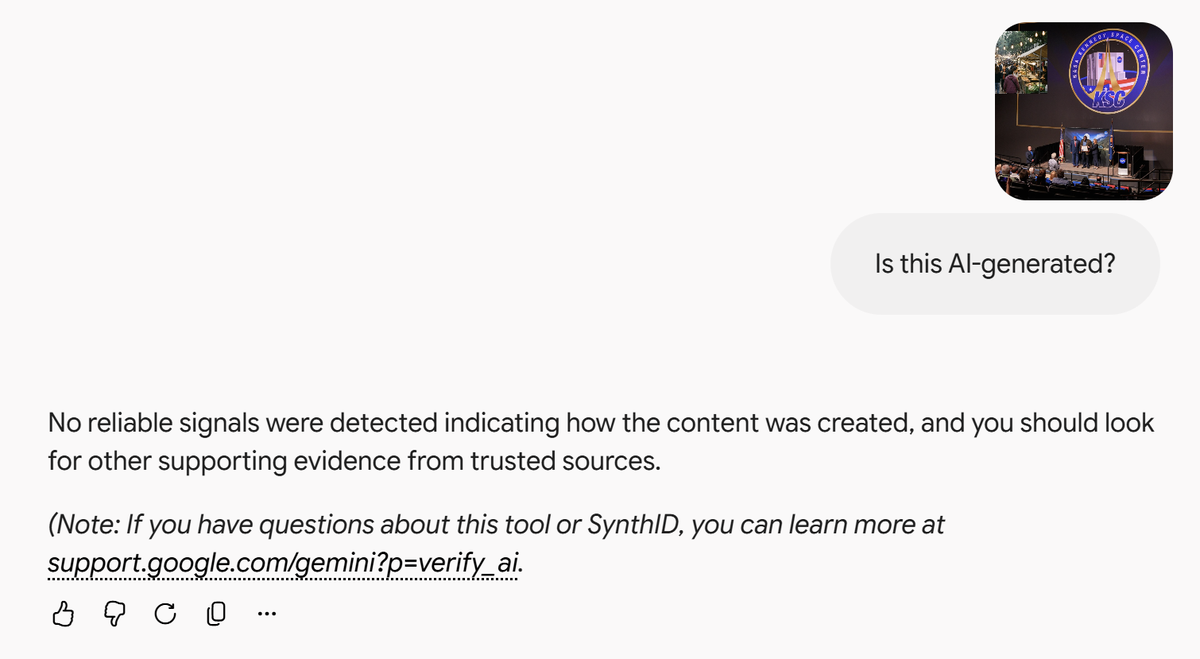
- the AI image pasted small into the corner of the real photo
The Detector was the plan, but on October 12 all four of my uploads, between 4:36 and 5:33 pm UTC, ended in "Something went wrong! Please wait and try again later." That included a 166 KB file, so it wasn't file size. So I used the SynthID check built into the Gemini app: a fresh chat for each file, my personal account, and the question "Is this AI-generated?"
I kept to things a normal user would check. The Detector's terms forbid using its results to work out which transformations break the watermark, so I didn't build a grid of crops, filters and compression levels.
The results
Content Credentials (the C2PA standard) are signed metadata that record how a file was made. SynthID is the watermark in the pixels. Here is what Gemini said about each file:
| File | Content Credentials in file | Gemini's answer | What it used |
|---|---|---|---|
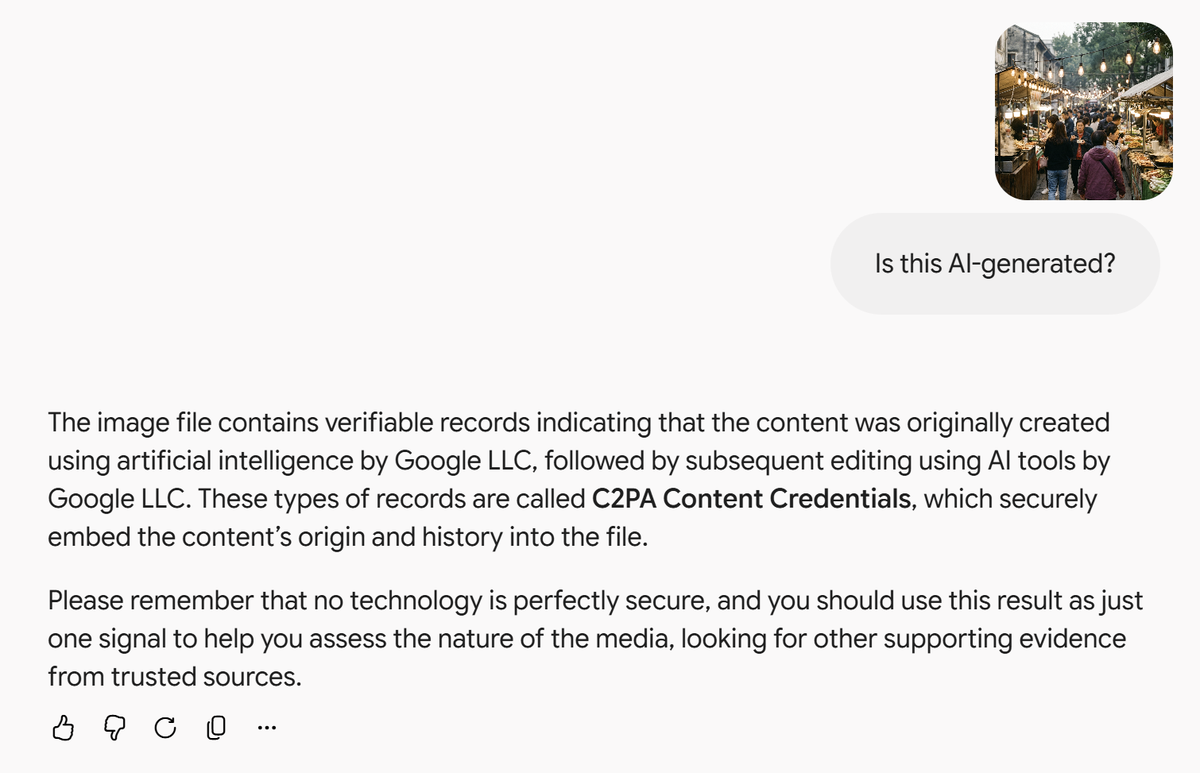
| Gemini image, untouched | Yes, signed by Google LLC | "created using artificial intelligence by Google LLC, followed by subsequent editing using AI tools" | C2PA metadata |
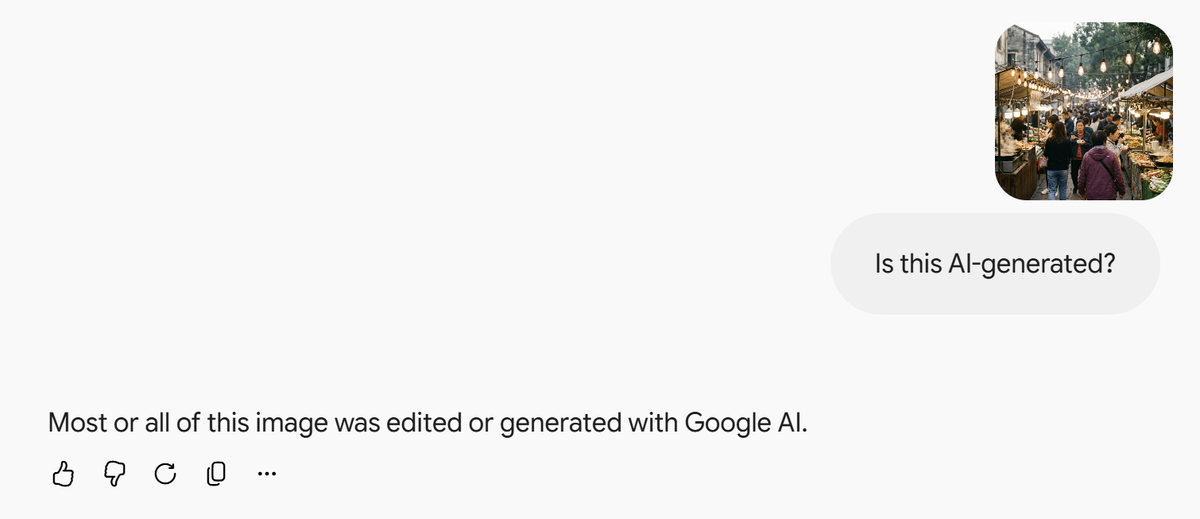
| Same pixels, metadata removed | No | "Most or all of this image was edited or generated with Google AI." (2 of 2 runs) | SynthID |
| Screenshot of it (PNG) | No | "Most or all of this image was edited or generated with Google AI." (2 of 2 runs) | SynthID |
| Real photo (NASA, 2023) | No | "No reliable signals were detected indicating how the content was created" | Nothing found |
| Real photo, sky edited in Gemini | Yes, signed by Google | "created as a generative AI creation and subsequently edited using generative AI tools" | C2PA metadata |
| AI image pasted small into the real photo | No | "No reliable signals were detected" | Missed |
Does SynthID work on screenshots?
It did in mine. A screenshot changes the image: it's rescaled to fit the screen, re-rendered by the browser and saved in a different format. Gemini flagged it both times. The second answer also said "No reliable C2PA content credentials were detected for this file", so the detection came from the pixels.
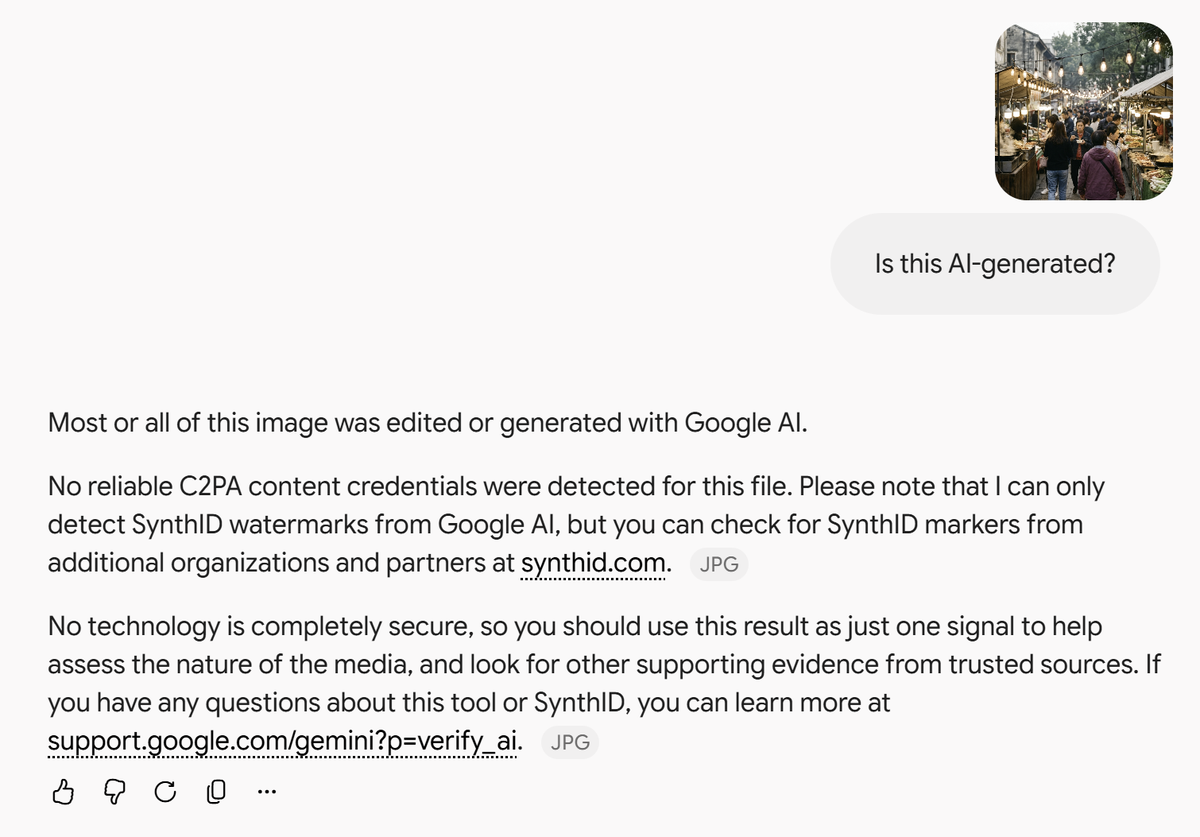
Not every screenshot test agrees. On October 8, Digital Information World reported that the Detector website flagged their image as a standalone file but not as a screenshot. Mine was cropped to the image and checked in Gemini, and theirs used the Detector, so the two aren't directly comparable. Either way, a screenshot is a weaker test than the original file.
Google's own claim is narrower. Its SynthID page says the image watermark is "designed to stand up to modifications like cropping, adding filters, changing frame rates, or lossy compression." Screenshots aren't on that list.
SynthID vs C2PA: the two labels inside a Gemini image
Every Gemini image I made carried two separate labels, and the check reads both.
| C2PA Content Credentials | SynthID | |
|---|---|---|
| Where it lives | Signed metadata in the file (about 6 KB here) | In the pixels |
| What it records | Who made it, which tool, edit history | Only that a Google or partner model made it |
| Survives a re-save or screenshot | No | Yes, in my tests |
| Who can read it | Anyone, with open tools | Google's tools only |
Removing the metadata, or re-saving the image as a 1080 px JPEG, deleted the C2PA manifest completely. The file then relies on SynthID alone. You can read the credentials yourself with c2pa-python (version 0.38.0 here):
import json
from c2pa import Reader

reader = Reader("gemini-image.jpg")
store = json.loads(reader.json())
manifest = store["manifests"][store["active_manifest"]]
print(manifest["signature_info"]["issuer"])
for assertion in manifest["assertions"]:
    if assertion["label"].startswith("c2pa.actions"):
        for action in assertion["data"]["actions"]:
            print(action["action"], action.get("digitalSourceType"))
Google LLC
c2pa.created http://cv.iptc.org/newscodes/digitalsourcetype/trainedAlgorithmicMedia
c2pa.edited http://cv.iptc.org/newscodes/digitalsourcetype/trainedAlgorithmicMediatrainedAlgorithmicMedia is the IPTC term for media created by a generative model. If you'd rather not run code, contentcredentials.org/verify reads the same manifest in the browser.
Is SynthID reliable? What a result tells you
A positive result is strong evidence. Gemini identified the untouched file from its metadata, and the stripped copy and the screenshot from the watermark, while the real photo came back clean. One photo isn't a false-positive rate, though.
A negative result is weak evidence:
- It only knows its partners. An image from a generator outside the SynthID scheme will always come back clean.
- It missed a composite. The same AI image, pasted small into the corner of a real photo, came back "No reliable signals were detected." Digital Information World saw the same on the Detector website: an AI image covering more than half of a new image came back as unlikely to be from a SynthID partner.
- The check has slipped before. In July, Lead Stories found that within one chat, Gemini repeated its verdict on the first file when asked about a second one, for images and videos. Google said on July 16, 2026 that a fix had rolled out globally. I still used a fresh chat for every file.
How to check an image yourself
- In the Gemini app, upload the image in a new chat and ask "Is this AI-generated?" In my tests it answered from C2PA when the file had it, and from SynthID when it didn't.
- On the SynthID Detector, sign in at synthid.com and upload the file. It covers Google's partners as well, and shows which parts of the image are most likely watermarked.
- For Content Credentials, use contentcredentials.org/verify, or the code above, to see the signed history, if the file still has it.
- Read a clean result as "unknown", not "real".
What about AI-generated text?
The image watermark is closed, but SynthID Text is open source. It ships in Hugging Face Transformers 4.46 and later as a watermarking config passed to generate(), with a Bayesian detector. Text detection is probabilistic, and I didn't test it here.
If you build image pipelines
Any step that decodes and re-encodes an image (resizing, thumbnails, format conversion) drops the C2PA manifest, as the 1080 px re-save above showed. If provenance matters to your product, carry the manifest through with the C2PA SDK rather than relying on the watermark alone. SynthID survived the re-save and the screenshot in my tests, but only Google's tools can read it.
Frequently asked questions
Does SynthID work on screenshots?
Sometimes. My screenshot of a Gemini image, cropped to the image and saved as a PNG, was flagged by Gemini's check in both runs, from the watermark in the pixels. Digital Information World's screenshot test on the SynthID Detector website failed on October 8, 2026. Use the original file whenever you can get it.
Is SynthID the same as C2PA Content Credentials?
No. C2PA Content Credentials are signed metadata stored in the file, and a normal re-save or upload removes them. SynthID is a watermark in the pixels themselves. Gemini images carry both, and Gemini's check reads whichever one it finds.
Can SynthID detect Midjourney or Stable Diffusion images?
Only if the generator embeds SynthID. Google lists itself, OpenAI, NVIDIA and Kakao as the companies whose watermarks the Detector reads, with Apple to follow. Anything else comes back as no watermark found, which says nothing either way.
Does SynthID have false positives?
A real photo came back clean in my test, but that is one photo, not a false-positive rate. Treat a positive result as strong evidence the image passed through Google's or a partner's AI tools, and a negative one as unknown.
Is SynthID open source?
The text watermark is: SynthID Text ships in Hugging Face Transformers 4.46 and later, with a reference implementation on GitHub. Image, video and audio detection is only available through Google's tools, such as the SynthID Detector and the Gemini app.